Why Stone-Milled Matcha Tastes Better: The Science of Particle Size Distribution

Short answer: Stone-milled matcha is not prized because its particles are the smallest. Japanese research shows that stone mills produce a broad particle size distribution, with a median of roughly 10 to 20 microns and a mix of finer and coarser particles, while jet mills produce much finer, more uniform powder. Tasters find that the stone-mill profile combines smoothness with a pleasant body. Understanding this distribution makes it possible to reproduce much of the stone mill's quality with modern milling at far lower cost.
Key takeaways
- In a 2010 study, stone-milled matcha had a median particle size of 18.3 µm, ball-milled 17.5 µm, and jet-milled only 2.9 µm.
- The stone-mill distribution was broad and non-normal; the jet-mill distribution was narrow and uniform.
- A 2019 review by the same lead researcher concluded that stone-milled matcha "combines texture and smoothness," which explains its appeal when drunk.
- Finer is not always better: very fine powder feels smooth but lacks body.
- Milling that mimics the stone mill's distribution can deliver similar quality at commercial scale.
How a stone mill works
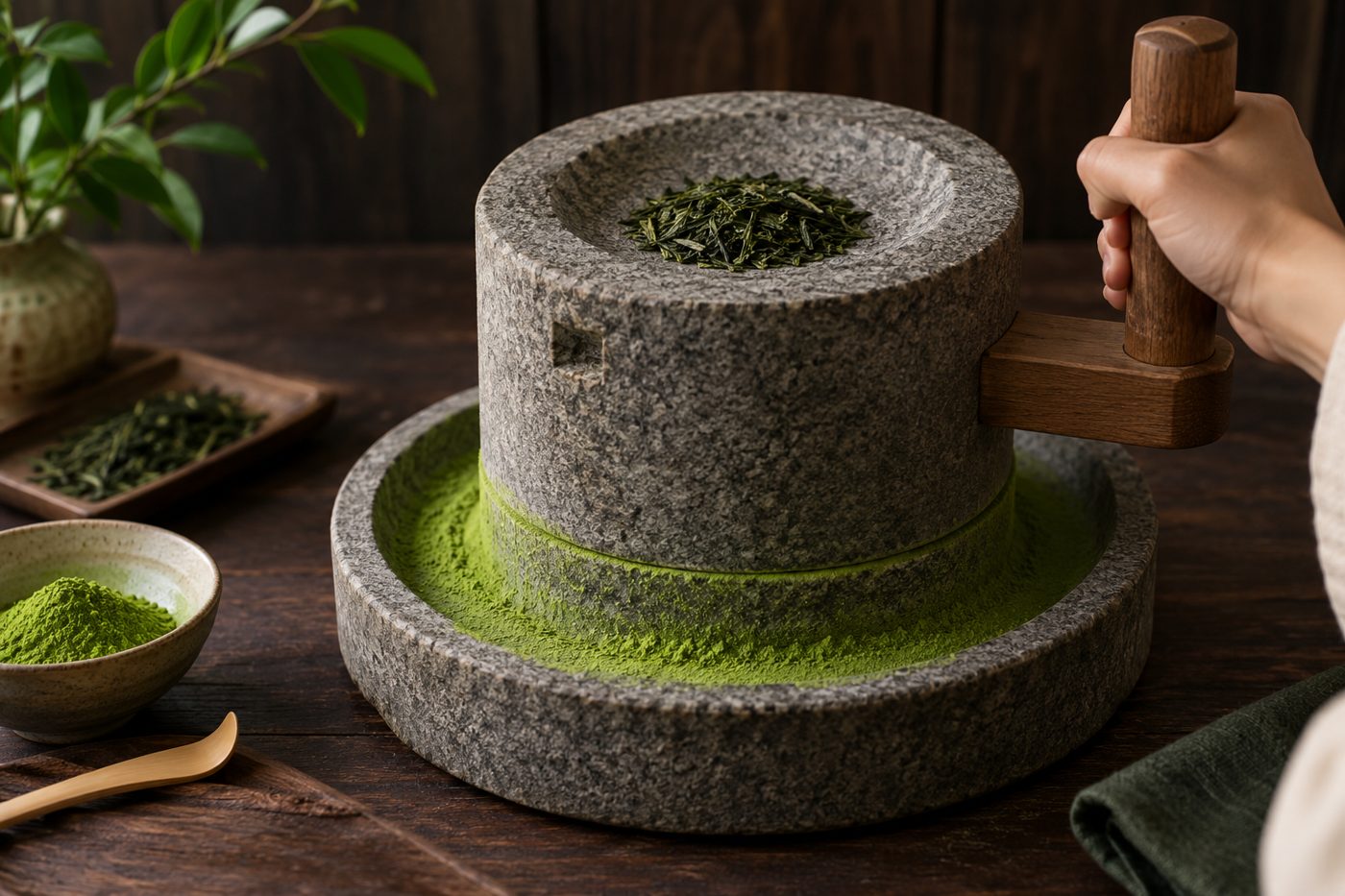
A matcha stone mill consists of two carved granite discs. The upper stone turns slowly, and tencha fed through a central hole is drawn outward along grooves, sheared between the stones and released as powder at the edge. Because the stones turn slowly to avoid heating the tea, a single mill typically produces only a few dozen grams per hour. That makes stone-milled matcha costly.
What the research found
In a study published in the Journal of the Japanese Society for Food Science and Technology (Nippon Shokuhin Kagaku Kogaku Kaishi, 2010), Sawamura, Haraguchi, Ikeda and Sonoda milled tencha with a stone mill, a ball mill and a jet mill, and measured the powders by laser diffraction:
| Milling method | Median particle size | Maximum particle size | Distribution |
|---|---|---|---|
| Stone mill | 18.3 µm | 75.1 µm | Broad, low uniformity, not normally distributed |
| Ball mill | 17.5 µm | 51.6 µm | Broad |
| Jet mill | 2.9 µm | 6.7 µm | Narrow, uniform, close to normal |
The researchers also measured particle shape. Stone- and ball-milled particles were less round (average circularity 0.84) than jet-milled particles (0.91). They explained that a stone mill grinds mainly by shear, splitting leaf along its fibers, while a jet mill shatters particles by impact. The finer jet-milled powder spread and flowed more easily and foamed well.
In a 2019 paper in the Tea Research Journal, Sawamura summarized the sensory side. Stone-milled matcha has a wide particle range with a median of about 10 to 20 µm. Ball-milled matcha can have a similar median but a different distribution and can feel gritty. Jet-milled powder at about 3 to 5 µm feels smooth but lacks perceptible texture. Stone-milled matcha, he concluded, combines texture and smoothness, which links to its perceived deliciousness.
Why distribution matters more than fineness
If the goal were simply the finest powder, jet milling would win. But in the mouth, a cup of matcha made from ultra-fine, uniform particles can feel thin. The stone mill's mix of particle sizes gives a velvety body while keeping most particles below the size the tongue perceives as grit. Shape matters too: the torn, fibrous particles from shear grinding behave differently in water and foam than the rounded fragments from impact milling.
Reproducing the stone mill at scale
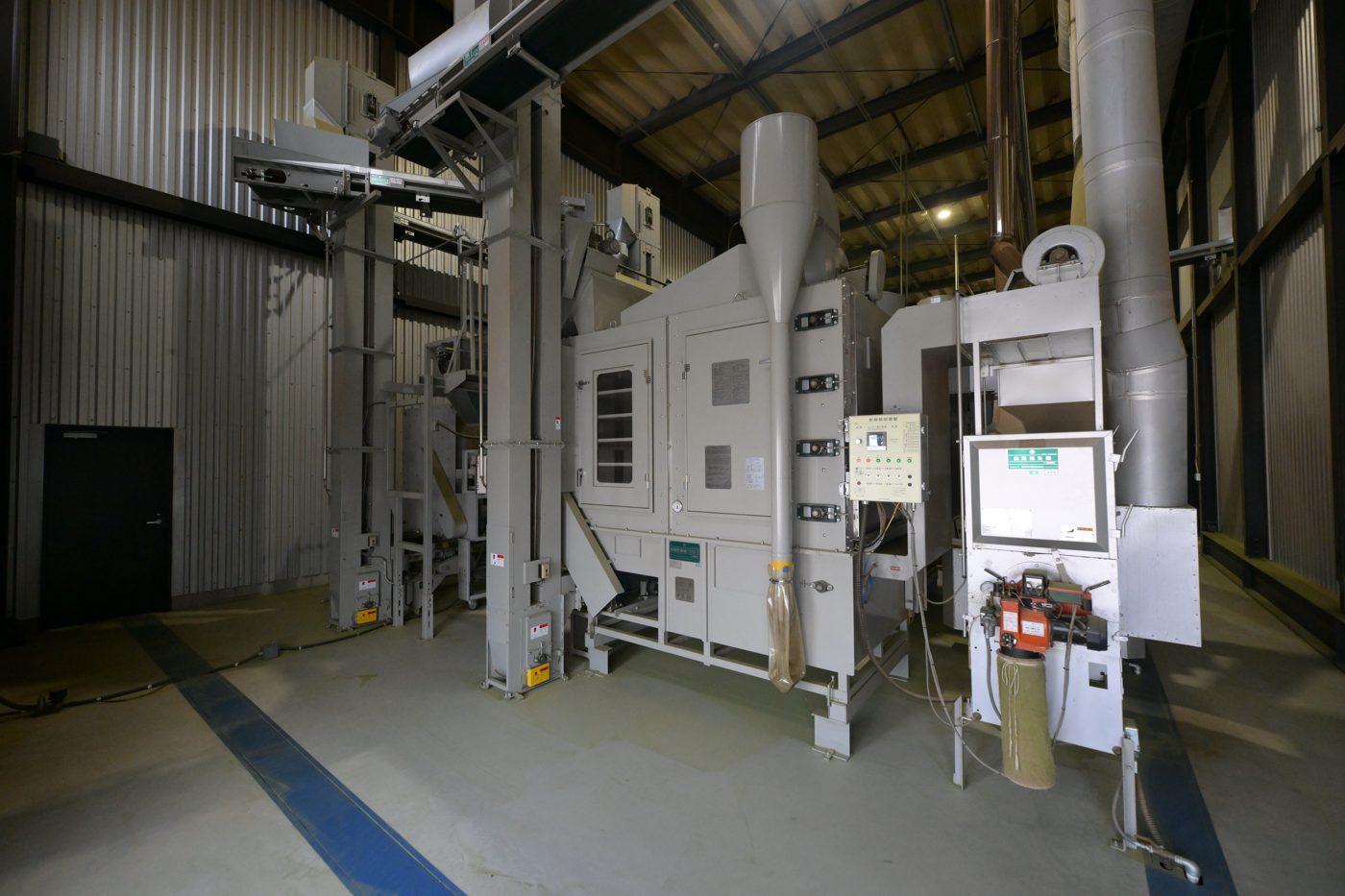
Once the target distribution is understood, it can be engineered. Modern mills can be tuned to shear rather than shatter, to control heat, and to produce a particle size distribution close to that of a stone mill. This is the logic behind "stone-mill-inspired" milling: aiming for the stone mill's sensory result without its very low output and high cost. Origin Leaf Japan's matcha is produced with stone-mill-inspired bead milling designed for consistent particle size.
What buyers should ask
- What milling method is used?
- Can the supplier share particle size data (D10, D50, D90)?
- How is heat controlled during milling?
- How soon after milling is the matcha packed and shipped?
Frequently asked questions
Q: Is stone-ground matcha always better?
A: It is the traditional benchmark for texture, but quality also depends on the leaf, freshness and milling control. Well-engineered modern milling can come close.
Q: Why is jet-milled matcha used at all?
A: Very fine powder disperses easily, which suits some beverages and food applications.
Q: What particle size is ideal?
A: There is no single ideal. For drinking matcha, research points to a stone-mill-like distribution with a median of roughly 10 to 20 µm.
Sources and further reading: Sawamura S., Haraguchi Y., Ikeda H., Sonoda J., "Properties and Shapes of Matcha with Various Milling Methods," Nippon Shokuhin Kagaku Kogaku Kaishi 57(7): 304–309 (2010); Sawamura S., "Matcha Deliciousness from the Perspective of Particle Size and Texture," Tea Research Journal 128: 31–35 (2019), DOI 10.5979/cha.2019.128_31.
Serving matcha in your café or building a matcha brand? Origin Leaf Japan supplies first-flush, single-origin matcha from Suzuka, Mie, to cafés, retailers, distributors and food manufacturers, milled to order with a 5 kg minimum, 1 kg packs, and delivery in as little as 10 days. Request a quote or samples →
MORE IN B
Cultivars, Cultivation and Craft
- 15 Why Japanese Tea Tastes Different from Chinese Tea
- 13 Why Fertilizer Unlocks a Tea Cultivar's Full Potential
- 12 A Short History of Tea Plant Breeding in Japan
- 11 Okumidori vs. Yabukita: Flavor, Color and Best Uses Compared