How Much Caffeine Is Actually in Matcha?

Note: This article is for general information only and is not medical advice. If you have a health condition, are pregnant, or take medication, consult a qualified healthcare professional.
Short answer: Matcha powder contains roughly 3.2 g of caffeine per 100 g according to Japan's Standard Tables of Food Composition, or about 32 mg per gram. A typical serving of 2 g therefore contains around 60 to 70 mg of caffeine, similar to a shot of espresso and less than an 8 oz cup of brewed coffee. Actual levels vary with harvest, cultivar and how much powder you use.
Key takeaways
- Japanese reference value: about 3.2 g caffeine per 100 g of matcha powder (about 32 mg per gram).
- A 2 g serving: about 64 mg; a strong 4 g latte: about 130 mg.
- Published lab analyses of matcha samples vary widely, so treat any single number as approximate.
- You consume the whole leaf, so dose depends entirely on how many grams you use.
- The US FDA cites 400 mg per day as an amount not generally associated with negative effects in healthy adults.
The numbers
| Drink | Typical caffeine |
|---|---|
| Matcha, 1 g powder | about 32 mg |
| Matcha, 2 g serving (usucha or standard latte) | about 64 mg |
| Matcha, 4 g serving (strong latte) | about 130 mg |
| Brewed coffee, 8 oz (240 ml) | about 80 to 100 mg |
| Espresso, single shot (30 ml) | about 60 to 65 mg |
| Sencha, brewed (per 100 ml) | about 20 mg |
| Gyokuro, brewed (per 100 ml) | about 160 mg |
Matcha, sencha, gyokuro and coffee figures per Japan's Standard Tables of Food Composition reference values where available; espresso and 8 oz coffee from common US reference values. Individual products vary.
Why matcha's caffeine varies
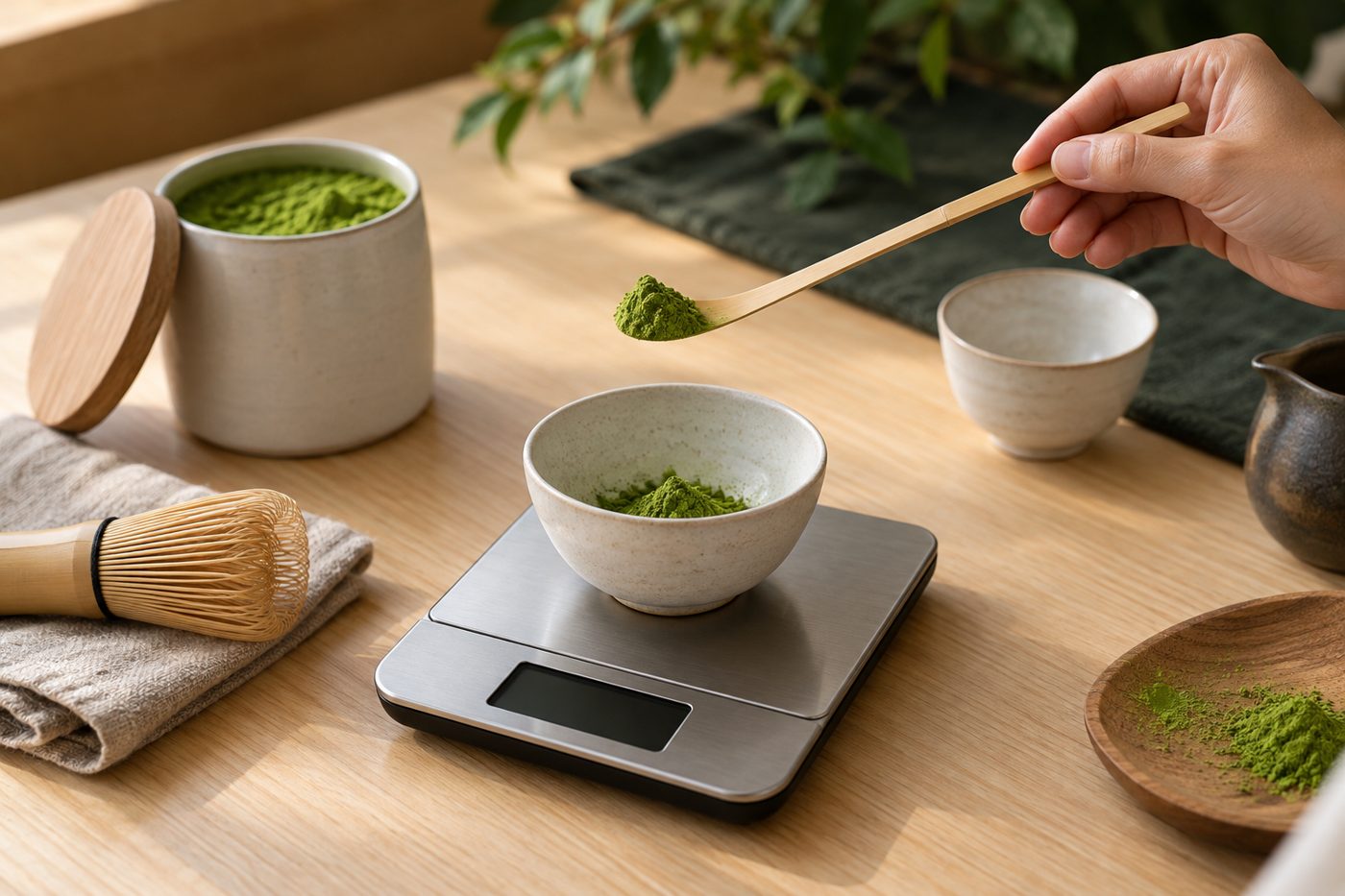
- Dose: Because matcha is the whole powdered leaf, doubling the powder doubles the caffeine.
- Harvest: Young first-flush shoots tend to be relatively high in caffeine.
- Shading: Shading does not reduce caffeine; shaded teas such as gyokuro are among the most caffeinated.
- Cultivar and processing: Different cultivars and processing methods produce different levels.
- Analysis method: Studies use different samples and methods, which is why published values differ.
Why matcha feels different from coffee
Many people report that matcha gives a calmer, steadier alertness than coffee. One proposed reason is L-theanine, an amino acid abundant in shaded tea that has been studied for its effects on relaxation and attention, especially in combination with caffeine. The evidence is promising but limited, and individual responses vary.
How much is too much?
The US FDA states that for healthy adults, 400 mg of caffeine a day is an amount not generally associated with dangerous, negative effects. Pregnant people are commonly advised to limit caffeine to 200 mg per day, and children and people sensitive to caffeine should be more cautious. Talk to a healthcare professional if you have questions about your own intake.
Tips for managing caffeine
- Weigh your matcha to know your dose.
- Avoid late-afternoon matcha if you are sensitive to caffeine and sleep.
- Consider hojicha, a roasted Japanese tea, as a lower-caffeine alternative in the evening.
Frequently asked questions
Q: Does matcha have more caffeine than green tea?
A: Per cup, usually yes, because you consume the whole leaf rather than an infusion.
Q: Does matcha have more caffeine than coffee?
A: A standard 2 g serving usually has less than an 8 oz cup of brewed coffee, but a 4 g latte can match or exceed it.
Q: Is there decaf matcha?
A: Decaffeinated matcha is rare. If you need to avoid caffeine, roasted or caffeine-free alternatives are better options.
Sources and further reading: Ministry of Education, Culture, Sports, Science and Technology (Japan), Standard Tables of Food Composition in Japan (2020, 8th revised edition); US FDA, "Spilling the Beans: How Much Caffeine Is Too Much?"; Foods (MDPI), "Matcha Green Tea: Chemical Composition, Phenolic Acids, Caffeine and Fatty Acid Profile" (2024).
Serving matcha in your café or building a matcha brand? Origin Leaf Japan supplies first-flush, single-origin matcha from Suzuka, Mie, to cafés, retailers, distributors and food manufacturers, milled to order with a 5 kg minimum, 1 kg packs, and delivery in as little as 10 days. Request a quote or samples →
MORE IN E
Health and Science
- 30 Green Tea and Cancer: What the Research Actually Shows
- 29 Does Matcha Really Help with Weight Loss?
- 28 What Happens When You Drink Matcha Every Day?
- 27 The Science Behind Matcha and Calm Focus