How to Create Your Own Japanese Tea Ritual at Home

Short answer: You can create a meaningful matcha ritual at home with four tools (a bowl, a bamboo whisk, a scoop and a fine sieve), good fresh matcha and water around 70 to 80 °C. The ritual matters as much as the recipe: warm the bowl, sift the matcha, whisk with attention, and drink slowly. Borrowing a few ideas from the Japanese tea ceremony turns a daily drink into a few minutes of calm.
Key takeaways
- Essential tools: chawan (bowl), chasen (bamboo whisk), chashaku (scoop) and a sieve.
- Use about 2 g of matcha (two scoops of a chashaku) and 60 to 70 ml of water at 70 to 80 °C.
- Sifting prevents lumps; warming the bowl keeps the tea at the right temperature.
- Whisk briskly in an M or W motion for about 15 to 20 seconds.
- Make it seasonal and personal: a small sweet, a flower, a quiet moment.
The tools
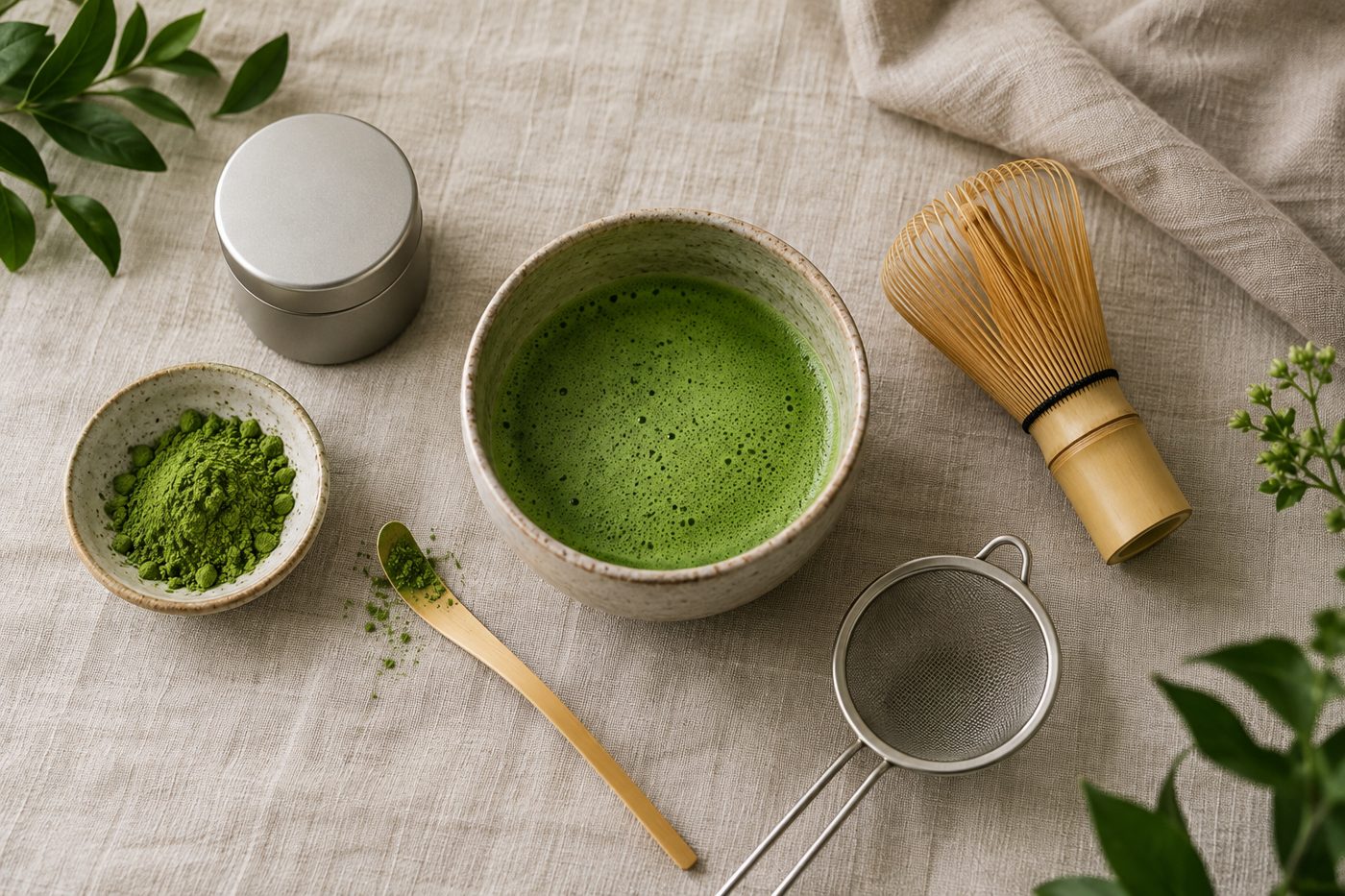
- Chawan: A wide tea bowl gives room to whisk. Any wide, heat-safe bowl works to start.
- Chasen: A bamboo whisk with fine tines creates the smooth foam. Soak it briefly in warm water before use to soften the tines.
- Chashaku: A bamboo scoop; one scoop is roughly 1 g.
- Sieve: A small fine-mesh strainer to remove lumps.
- Optional: A whisk holder (kusenaoshi) to keep the whisk's shape, and a cloth for wiping the bowl.
Step-by-step usucha (thin tea)
- Prepare your space. Clear a small area. Many people like to add a single flower or seasonal object.
- Warm the bowl and whisk. Pour hot water into the bowl, dip the whisk in it, then discard the water and dry the bowl.
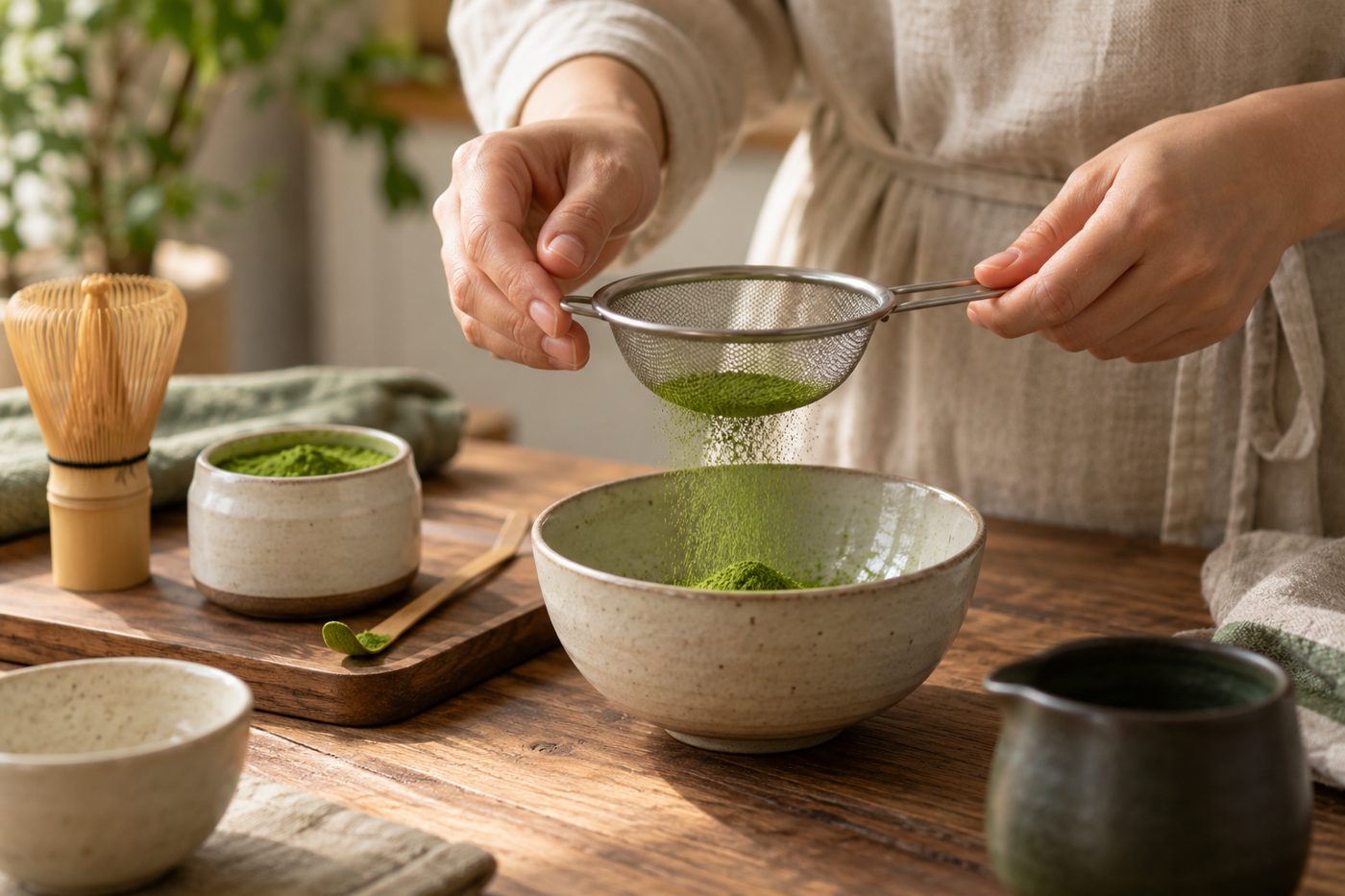
- Sift the matcha. Sift about 2 g (two scoops) into the bowl.
- Add water. Pour 60 to 70 ml of water at 70 to 80 °C. If you only have boiling water, let it cool for a few minutes.
- Whisk. Hold the bowl steady and whisk briskly from the wrist in an M or W motion for 15 to 20 seconds, until a fine foam forms. Finish by drawing the whisk gently to the center and lifting it out.
- Drink mindfully. Hold the bowl in both hands, notice the color and aroma, and drink in a few sips.
- Clean up. Rinse the whisk in warm water (no soap) and let it dry on a holder.
Ideas borrowed from the tea ceremony
- Seasonality: Choose a sweet, a bowl or a flower that reflects the season.
- A small sweet first: In tea gatherings, guests eat a sweet before drinking, which balances matcha's slight bitterness.
- Attention: Put your phone away for five minutes. Focus on the sounds of water and whisk.
- Ichigo ichie: Treat each bowl as a unique moment.
Making it part of daily life
Some people make their matcha ritual a morning start instead of coffee; others use it as an afternoon pause. Consistency matters more than perfection. Fresh matcha makes a real difference: store it sealed in the fridge and bring it to room temperature before opening.
Frequently asked questions
Q: Can I use an electric frother?
A: Yes, especially for lattes. A bamboo whisk gives a finer foam and is part of the ritual's appeal.
Q: Should I add sugar?
A: Good matcha is naturally sweet and savory. Try it plain first, perhaps with a small sweet on the side.
Q: What is the difference between usucha and koicha?
A: Usucha is thin, whisked tea. Koicha is thick tea made with roughly twice the matcha and much less water, kneaded rather than whisked, and requires very high-quality matcha.
Sources and further reading: Japanese tea school guidance on usucha preparation.
Serving matcha in your café or building a matcha brand? Origin Leaf Japan supplies first-flush, single-origin matcha from Suzuka, Mie, to cafés, retailers, distributors and food manufacturers, milled to order with a 5 kg minimum, 1 kg packs, and delivery in as little as 10 days. Request a quote or samples →
MORE IN D
Culture and History
- 23 Why Japan Turned Tea into an Art Form: Chanoyu and Wabi-Sabi
- 22 The 800-Year Journey of Japanese Matcha